Showing posts with label Character History Posts. Show all posts

Friday, May 29, 2020

Batwoman: The History, Legacy & All the Knockoffs

Disclaimer: Hey folks, Blogger is updating their format, so if any elements seem wonky, I apologize. I'm still trying to adjust to the new format, which I'm liking, though missing tools like the emojis. Please bare with me during this time of transition. Thank you, now back to your daily scheduled blog post.

Welcome back to the Tramway!

And welcome back to another Character History post, where I talk about the history of characters, usually from comic books.

Today, I break the trend of covering golden age/public domain characters and discuss a larger, mainstream character. We're digging into the history of Batwoman, from her bonkers real life origin and the knock offs. Trust me, it's gonna get weird! I wanted to talk about Batwoman because I recently became a fan through the CW TV show, and I decided to investigate her history.

Batwoman (Kate Kane).png
Detective Comics #860 textless cover. Image Credit: DC, used under the Wikipedia Creative Commons Share Alike License. Fair use, https://en.wikipedia.org/w/index.php?curid=22388623


With the news that Ruby Rose is leaving the show (that makes me the big sad) I wanted to discuss the history of the character, and now seemed like an appropriate time.

But before we do that, let's discuss mainstream Batwoman's origins.

DC Batwoman: Origins


Pre-Crisis Batwoman Image Credit: DC, Comic Vine

Now, if you're familiar with Batwoman from the CW show, than you're going to be really confused by the picture above. Whose this weird, yellow Batwoman? Brace yourselves....

Batwoman, alias Kathy Kane, first appeared in Detective Comics No. 233, published in 1956. She was created by Bob Kane (co-creator of Batman) and Sheldon Moldoff, according to Comic Vine. Before we get into the reason she was invented, let's discuss who she is as a character.

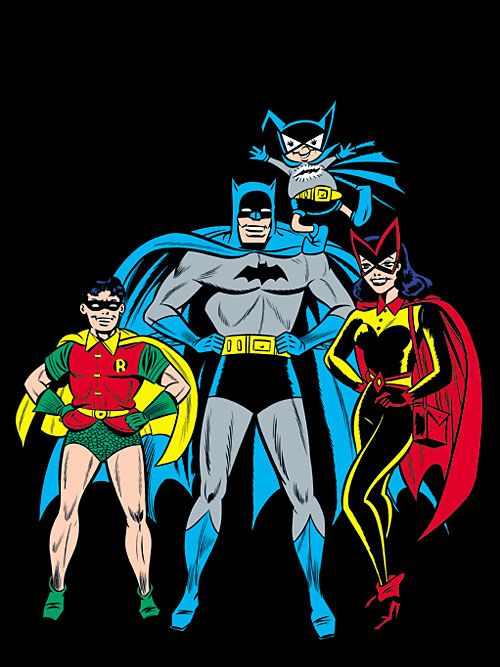
Kathy Kane was basically Robin and Batman's origins rolled into one character. She worked at a circus, was the heir to a wealthy family, and was inspired by Batman. She decided to become Batwoman, though Batman was not impressed, because he feared for her safety. (You gotta love the 50's). However, Kathy persevered, and eventually became accepted by the Cape Crusader. Her niece, Betty Kane, found out about her secret, and became the first comic Bat Girl. That's right, Barbara Gordon is NOT the first Bat Girl.

And even then, Batwoman (who let me remind you, was discouraged from being Batwoman) tries to discourage her! How do you spell double standards? I mean, she is pretty young, but also... Batman has Robin. You know, once you start trying to bring logic to comics, it starts to fall apart.
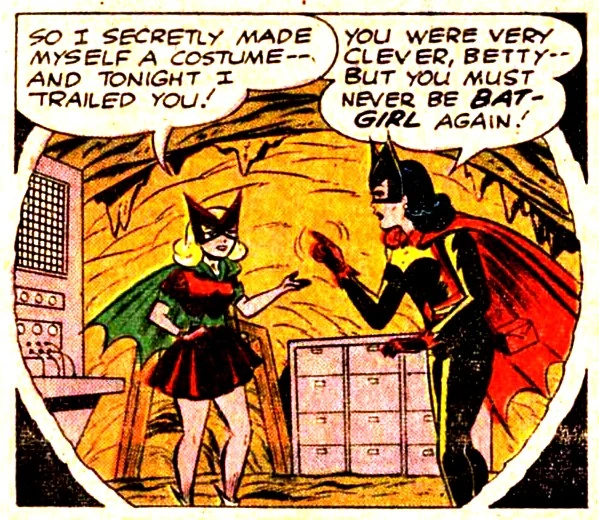
The original Batwoman and Bat Girl. Image Credit: DC Wiki. https://dc.fandom.com/wiki/Katherine_Kane_(Earth-One)

The introduction of Batwoman and Bat Girl would begin to expand the dynamic duo into what would become known as the Bat family. More characters were added, and still are to this day.

Kathy Kane Batwoman with the Bat Family. Image Credit: DC Wiki.
https://dc.fandom.com/wiki/Katherine_Kane_(Earth-One)

However, there were more sinister (or dare I say, stupid) reasons behind Batwoman's creation. According to History.com, Batwoman was created by DC for a very specific reason. It wasn't, as you might suspect, to protect the copyright and ensure no one created a Batwoman character before DC could.

The reason? They were afraid people would say Batman and Robin were gay.

And no, I am NOT making this up.

The "fear" of Batman being percieved as gay came from the book Seduction of the Innocent, written in 1954 by German psychiatrist Fredric Wertham, according to History.com. Wertham is known as the boogey man of comics. Because of Dr. Wertham, comics had to self censor themselves with the Comics Code Authority, due to the unfair and idiotic accusations that comics were making kids criminals and were destroying their spiritual health.

Dr. Wertham is proof that old white men don't understand popular culture, and shouldn't try and censor what they don't understand. Especially when, like Wertham, you base your claims on inaccurate research. But let's get back to Batwoman.

To make Batman "safe," DC had to create a female love interest for him and Robin, hence why we have Batwoman. Overtime, when the power of the Comics Code Authority became more relaxed, the need for Batwoman decreased. So what do you do with a character you don't need? Have them retire happily? Make them a supporting character? No of course not, you kill them!

Batwoman was killed in 1979, and stayed dead after DC's reboot known as Crisis on Infinite Earth. Her death was apparently done by the League of Assassins according to DC Wiki, though Comic Vine states it was by Bronze Tiger. Comics continuity is very confusing.

I don't have any nostalgia for for Kathy Kane Batwoman, but her murder doesn't sit well with me. In particular how the DC Wiki says that Batman was motivated to avenge her death. This means that Kathy was fridged, a term created by comics writer Gail Simone. Essentially, the term (in reference to a Green Lantern comic, where a female love interest is murdered and stuffed in a fridge) means a female character is wounded or killed to motivate a male character.

Kathy Kane Batwoman would stay dead for over 30 years in comics, which, given how much characters are brought back to life, is pretty impressive. However, when she was rebooted for modern day comics, she was reinvented in a much more imaginative way, and one that would make Dr. Wertham spin in his grave.

DC Batwoman: Reboot/Modern 


Kate Kane would be the next Batwoman to grace the pages of comics. As you do with a reboot, her origin was changed from Kathy's.

Kate, who is Jewish, grew up as a military brat, according to Comic Vine. And she had a sister, Beth. On their 12th birthday, their car was crashed by terrorists, the Kanes were kidnapped. Kate's dad launched a rescue for them, but the mission ended in a near failure, their mother was dead, and Beth was (assumedly) dead, parodying Batman's origin, though making it her own.

Kate followed in her father's footsteps and joined the army, quickly climbing up the ranks. However, her career was cut short when she was accused of homosexuality.

Which was true. Yes, that's right. Batwoman, the character created to ward off fears of a gay Batman, became an open lesbian superhero. Cop that Wertham!

Kate had to resign, and this led her into a depression. To keep this post from being too long, I'm going to skip the crazier parts of her origin, and get to the meat of the story. After getting saved by Batman, Kate took inspiration from him, similar to her Pre-Crisis predecessor, and thus Batwoman was born. Kate became apart of the Bat Family over time, which is funny, because she is also Bruce Wayne (Batman)'s cousin.

Kate Kane Batwoman was created by several comics alum: Geoff Johns, Grant Morrison, Greg Rucka, Mark Waid, and Ken Lashley. In short: the rebooted Batwoman was in good hands.

Batwoman's redesigned costume is, in my opinion, a LOT better than the original yellow costume. The new Batwoman costume is an all black suit with a red bat logo, with Kate also wearing a bright red wig. Another interesting difference (at least in some comics/cartoons) is that Batwoman carries a gun, but she doesn't kill, following Batman's code.

Batwoman #1 Cover. Image Credit: DC, By Source, Fair use, 

Now, to avoid spoilers for the CW show, I'm not going to go into the rest of the details of who Batwoman fights. If you are familiar with the show, you will know her main villain is Alice, who is a leader (in the comics) of a cult, whereas in the show its the Wonderland Gang. 

I'll offer my thoughts on the CW show at the end, for now, I want to discuss the knockoff Batwomen. And if you thought her real life creation origin was weird, get ready to continue down the rabbit hole of madness.

Batwoman Knockoffs


Whenever one has success, there's likely to be knockoffs that come along. And this' true for Batwoman. 

The first was the Wild World of Batwoman, "created" by Producer/Director Jerry Warren, according to Dark Corners Reviews. The Wild World of Batwoman was made in response to the popularity of the Batman 66 show, which ironically did not have a Batwoman (But it did have Bat Girl).

Batwoman, with a group of "special" agents, who are referred to as Bat Girl (insert number here), fight crime.... kind of. It's just trash. Katherine Victor, who plays Batwoman, had to make the costume herself, and it's not very good. She literally has a bat symbol over her cleavage painted with mascara. I don't recommend you try and hunt down the film, but I do recommend Dark Corner's review of it. He really points out the clanky, silly parts, and it's a really fun video. You can find the video here.

The second Bat-knockoff came in 1968 (and probably inspired by the Batman 66 series again) is.... Mexican Batwoman. Yep, you read that right.

The official title is The Batwoman, though it is often referred to as (officially and unofficially) The Mexican Batwoman. And if you thought the first Batwoman-knockoff's costume was bad, well... take a look at the poster below.

m.media-amazon.com/images/M/MV5BODJiMjM3YTEtZDk...
The Batwoman (1968) Poster. Image Credit: IMDB, www.imdb.com/title/tt0235608 

Yeah... it's not great. Yet somehow not as bad as that yellow original costume.

The plot for Mexican Batwoman is sillier than the previous knockoff. Here, Batwoman is called in to investigate the murder of several wrestlers. And unlike the Batfamily, Mexican Batwoman is willing to shoot anyone who gets in her way, according to BlameitonJorge.

I learned about Mexican Batwoman from BlameitonJorge, and I recommend you check out his channel. Unfortunately, he removed the video from his channel, but you can find it on Rob's Media Archive. I don't normally recommend watching reuploaded videos, but Jorge (as far as I know) hasn't stated anything about it, and it hasn't been taken down. Which makes sense, given Jorge's channel revolves partly around lost media, it seems fitting that it's been saved on another channel. You can find the video here.

That's all of the Batwoman knockoffs I could find, but I'm sure that there's more out there. If you know of any, let me know, and I might update the post.

All right, now for my final thoughts (and thoughts on the CW Show)

CW Show/Final Thoughts


I was introduced to Batwoman through the CW series, and I've fallen in love with the character through it. Ruby Rose as Batwoman is really fun to watch on screen, and I enjoy her cast of supporting characters. They have a lot of fun moments and their own motivations that make them compelling. Unfortunately, the season was cut short due to the Coronavirus Pandemic. I haven't seen the finale yet, because it has a crossover with Supergirl and I need to catch up on the latter show. 

The show starts off pretty slow, so if you're planning to watch it, be prepared to possibly slog through some episodes. The show picks up when she gets the full costume. Alice is a fun villain, who you sympathize with as the show reveals what happened to her, but you also realize that she needs to be stopped.

I'm really sad to see Ruby Rose go. I feel that she really looks like the character, and played the part with passion. I also hope that her reasons for leaving weren't due to the harassment she faced online when taking the role. I believe that she had an accident on set, which was the reason given. In any case, thank you for a great season Ms. Rose, and best of luck with your future projects. You'll always be Batwoman to me.

Overall, Batwoman is an interesting character. Starting off as way to ward off fears of a gay Batman, she was transformed into a symbol for representation. And that seems like a fitting fate for the character. (again, cop that Wertham!!) She's much more successful now, and doesn't appear to be going anywhere. With the popularity of superhero films, maybe we'll see her make a cinematic appearance. But that probably won't happen until Warner Bros. gets Batman re

I recommend you check out Batwoman (the official Batwoman, not the knockoffs) in any form. If you want a good jumping in point, I recommend Batman: Bad Blood, though that film has previous continuity from previous films. I'm not as familiar with her comics as I'd like to be (breaking into comics is unfortunately still hard, especially if you're on a budget) but if you can find a collection of her comics for a good price, consider checking her out, and maybe support a local comic book store. Like regular book stores, they're really struggling during these hard times.

All right, who wants some Fun Facts?

Fun Facts


Kate Kane Batwoman's first animated appearance was in the movie Batman: Bad Blood, as part of the current series of DC's Direct to DVD Universe, according to Comic Vine. However, it was not the first time a Batwoman appeared in an animated form.

In the DC Animated Universe (DCAU for short), Batman: Mystery of the Batwoman, released in 2003, we see a similar looking Batwoman to Kate's but with a silver costume. That Batwoman (no spoilers) was a one off, which is really sad. I wonder if we'll ever get a Batwoman The Animated Series. I'd watch that. 

A Batwoman stand in, based on the original, appeared in the show Batman the Brave and the Bold.

Kate Kane's last name is a homage to Batman Co-creator Bob Kane. (Look, I had to fill the quota for fun facts, okay? Sue me XD )

Kathy Kane Batwoman returned to canon in the book Batman, Unlimited. I haven't read it yet, so I can't offer any thoughts on it, but it's fun to see her return. I personally think having her in the same universe as her successor could be weird. In my opinion, it would've made more sense to put her on a different Earth in a different universe. 

The Batgirl we all know and love, Barbara Gordon, actually appeared in the Batman 66 series first. 

Batwoman's first appearance on the CW was in the crossover series Elseworlds, which the first season of the show flash forwarded to. 

Thanks for reading this week's post. Have you seen Batwoman in any media form? What're your thoughts on the character? Let me know on Blogger, Facebook, or Twitter. If you enjoyed this character history post, please consider sharing it on your preferred social media(s), so we can build the Tug & Tram Community. Thanks, and I'll see you on the Tramway!

Sources:

"Batwoman." DC Wiki. https://dc.fandom.com/wiki/Katherine_Kane_(Earth-One)

BlameitonJorge. "8 Bootleg Superhero Movies." 

     www.youtube.com/watch?v=fuPcfGWm8fk&t=353s

Ciampagla, Dante A. "Fear of a Gay Batman Brought Batwoman to Life." History.com 16 August,      
     2018. Updated 12 June, 2019. www.history.com/news/gay-batman-fears-batwoman 

Dark Corner Reviews. "The Wild World of Batwoman." 27 January, 2020. 

"Kathy Kane." Comic Vine. https://comicvine.gamespot.com/kathy-kane/4005-81174/

Thursday, February 27, 2020

The History of Mighty Man: The Forgotten Propaganda South African Superhero

Welcome back to the Tramway.

Today we delve into the history of another forgotten superhero, though unlike our previous characters of discussion, this one is more recent. Another difference from previous posts is that this character is not from an American publisher, but a South African one. Prepare for a wild ride folks, because we're looking into the history of Mighty Man: The Forgotten South African Propaganda Superhero.

a static image rendering a preview of the first page of the PDF document
Cover of Afri-Comics #1. Source: UCLA Library, International Digital Ephemera Project. http://idep.library.ucla.edu/search#!/document/africanephemera:20

Before we begin, I want to mention that this series was inspired by Mr. Rogues, who does videos on superheroes and super villains. You can find one of his videos here.

General Info/Origin Story

Mighty Man's alias is Danny Ndhlomo, who lives in Soweto, South Africa. In Afri-Comics #1, published by.... we'll get to that later (believe me, the history behind this comic deserves a section to itself) we learn that Danny is a Cop. He's injured in the line of duty and shot. Thankfully, Danny survives, but the doctor (a white doctor I should mention, keep that in mind, it will become important later) cannot remove the bullet, because it landed too close to Danny's heart.

Still wanting to help the public, Danny re-enlists and is transferred to the records department, where he meets Donna Buthelezi, his boss and love interest.

Danny and Donna get along well, which helps. Donna's brother is kidnapped, and she's blackmailed by a local gang to steal police files on the gang. Danny catches her leaving with the files, but takes the blame, and goes on the run. He climbs onto a truck, which he falls off of in the jungle. As it goes during superhero origins, things go from bad to worse.

It begins raining, and Danny's heart begins to give out. The universe, deciding to give Danny a hand, shoots down a lightning bolt and opens a path to an underground cavern system. Danny crawls in for shelter, but the pain returns when he tries to get a drink of water, and falls in.

Then... underground aliens find him? It's-really hard to explain, so I'll just let you read it and see for yourself.


You REALLY can't make some of this shit up, can you? Image Credit: Afri Comics No. 1, UCLA Library. https://idep.library.ucla.edu/search#!/document/africanephemera:20

The underground aliens heal Danny, removing the bullet and give him powers. Returning with a costume the underground aliens give him, Danny swears to use his powers for good. Thus, Mighty Man is born.

All things considered, I think Mighty Man has an all right costume. The mask is slightly weird, but the color balance is pretty good. It might seem similar to another, more popular American superhero. That's right, Mighty Man is a rip off of... Superman.

Big surprise am I right? 

The costume is nearly identically, color wise, except the M is moved to above the belt, with some yellow lining added for good measure, and of course the addition of the mask. However, there is one big difference between Superman and Mighty Man.

Superman has a history of fighting against discrimination, that's what he stands for. Most famously, he fought the KKK in a 1950's Radio Show, which was retold in a recent comic run "Superman Smashes the Klan," (I won't go into too much detail on that here, as that's a blog post for another day).

Mighty Man, on the other hand, was a propaganda weapon who NEVER addressed the issues in South Africa at the time, in particular the Racism of the Apartheid Regime. Let me explain.

Real Life Background

So who published Mighty Man and Afri-Comics? The South African Apartheid Government.... kinda. You see, according to an article by Business Insider South Africa, the Apartheid Government were trying to find new forms of propaganda to counteract Communism, and Anti-Racism, while trying to make themselves look like the source of Law and Order. AND, encouraging Law and Order by telling people to not not question the system in place.

Though one quote claims the comics were to "help educate the black man in the ways of Western society, social concerns and free enterprise,” according to John McGoff, an American collaborator on the project, we all know. We all know.

That's right, Americans also helped with this. Afri Comics were made in New York by Manville Inc., a market research company which did an analysis of what the Apartheid's government in 1973 was to the rest of the World. The man who oversaw the comics was Eschel Roodie, the Secretary of the Department of Information. Jan van Zyl Alberts, a South African businessman, was the front man of the business. 

Now if you're like me, you might know much about South African Apartheid. (We learned it in high school, but it wasn't very in depth). Let's backtrack a little. In 1948, according to History.com, the National Party began Apartheid, essentially the South African equivalent of Jim Crow. (Even to the point where, on the History.com website, there's a photo of a sign that reads "Caution: Beware of Natives.)

Indigenous Africans were forced to live in separate areas from their White Overlords, and contact was made as limited as possible. Which's why there's so few white people in the Mighty Man comics. 

Interracial marriage was outlawed in 1950, and that was with 4 groups: Bantu (Black Africans), "Colored" (their language choice, not mine, biracial), white, and Asian (people from India or Pakistan). 80% of the land was set aside for the White Supremacists, and non-whites were forced to have passes to go into the "restricted" areas. The term used was "Separate Development," aka "Separate But Equal," aka "We're racist and we don't want to interact with you." 

Now that we have that context, let's return to Mighty Man

Backlash/Death of Mighty Man

17 issues of Afri Comics were produced, and 470,000 copies were made from 1975-77. Now, Afri-Comics failed as propoganda. Why? Because people were not fooled by it!

The worst example of the racism is in the roles people play in the comics. For example, white people are never portrayed as the villains in any of the stories. Also, the doctor who heals Mighty Man is white, while the nurses are all black. There's a lot of coded racism that's trying to subconsciously tell people what they can and can't do. Thankfully, the young people of Soweto saw right though it.

In 1976, Soweto students burned Afri Comics in protest of the Apartheid Regime, during the Soweto Uprising (You can read about that here). The University of California Los Angeles, who have preserved the comics, go into more detail on their website. During the uprising, students burned newsstands and threw the comics onto the ground, which caused the US Publishers to back out. 

What was "worse" for the Regime, the amount of money they were spending (secretly) on the comics were revealed by the Rand Daily Mail, a South African newspaper, during what was called the "Information Scandal." Eschel Roodie, according to the ACLU website, had to leave South Africa after being charged with misappropriating funds, (even though they told him to go ahead), he escaped to the US where he stayed until he died in 1993. 

The Apartheid Regime spent R64 Million (In US Currency today is around $4,133,969.92). That's a lot of money to spend on a comic that doesn't do it's job. With their propaganda exposed, the Apartheid Regime ended Afri Comics, and Mighty Man fell into obscurity.

If it were not for the UCLA Library, Mighty Man might've been lost to our general knowledge. Thankfully, Professor William H. Worger had collected all of the comics, and they were digitally scanned. So now you can read the comics for free, and the history of the lesser known propaganda has been preserved.

Which is thankful, because so few copies exist. This' likely due to the Soweto Uprising and the negative reputation the character had.

And before I finish up with my personal thoughts, a quick fun fact:

The Apartheid Regime gained the idea for making a comic... from the CIA. According to the ACLU Website, according to a quote from Jan van Zyl Alberts, who had friends in the CIA.

If I Rewrote Mighty Man...

So here's a little fun, for these history posts I'm going to do a segment called "If I Rewrote," where I'll give ideas for how to improve on what came before.

Which's ironic, because I wouldn't rewrite this character. I considered it (genuinely, I should say) and I had a discussion with a fellow comic fan over whether or not you could use Mighty Man. My friend said no, because of the history. I argued that you could make the character stand for something new.

And maybe you could. However, I don't think I'm the person for the job, as a white guy and someone who knows nothing about South Africa, this' a character that is best left in the past, as a historical example of what not to do.

And honestly, I do not think the world needs a re-imagined Mighty Man. We have good African Superheroes such as Storm, Black Panther, and Shuri, and African-American superheroes such as Ri Ri Williams (aka Iron Heart), Falcon, War Machine and who could forget Miles Morales Spider-Man?

All right, so I can actually set a tone for this mini-series,

If I Rewrote Mighty Man, I would make him tackle South African Apartheid, and have the Apartheid Regime freak out when he goes public. Which makes sense, and they WOULD freak out if a super powered African came into existence.

The Apartheid Regime would probably hunt down Mighty Man, making him loose his faith in the Police Force, and I could see him joining the Soweto Uprising.

In any case, we're not likely to see Mighty Man re-imagined anytime soon, which I think is fine. The legacy of the character's Apartheid Creation would always haunt any new version.

If you want to read a perspective of someone who lived in South Africa at the time, I ran across this blog, but didn't feel a need to cite it, but still want to give it a shout out. You can find it here.

So what do you think of Mighty Man? If you were to try and tackle remaking Mighty Man, what would you do? Let me know in the comments below, or my Facebook page for the blog, @TugTramBlogging. Thanks for reading, and I'll See You on the Tramway!

Sources:

"Afri Comics." UCLA Library, International Digital Epherma Project.

http://idep.library.ucla.edu/search#!/collection=Afri-comics

"Apartheid." History.com. www.history.com/topics/africa/apartheid 

"Information Scandal." SAHistory.orgwww.sahistory.org.za/article/information-scandal

Villiers, James de. "The apartheid government created a black superhero called Mighty Man – and in 1976, black youth set him on fire."

www.businessinsider.co.za/apartheid-government-spent-millions-educate-black-man-comic-youth-day-2018-6 

Friday, September 6, 2019

Yankee Doodle Dandy! The History of Yankee Girl: The (Forgotten & Somewhat) Forgotten Golden Age Superhero

Hello Star Tugs,

Welcome back to the Tuggin' & Trammin' Blogging blog. If this' your first blog post you've read from me, welcome! Thanks for taking the time to check out my blog.

Today, I will be doing another "The History of" blog post, where I discuss, as the name implies, the History of my topic. Today's topic is Yankee Girl: The (Forgotten & Somewhat) Forgotten Golden Age Superhero.

If you've read my blog for a long time you'll know that I'm a bit of a lover of Golden Age and public domain characters. (You can check out my blog posts The History of Lady Luck and the Do's and Don'ts of Public Domain Characters for reference).

A lot of the characters I have learned about from the Golden Age (including Lady Luck and today's subject) are due to the Public Domain Superhero Wikipedia. Without this great source, these characters would be forgotten. I'll leave a link if you'd also like to explore the public domain superheroes, and maybe even get your own inspiration to use a character. Go wild! https://pdsh.fandom.com/wiki/Public_Domain_Super_Heroes

(But make sure to check out my Do's and Don'ts reference page as well, to help you along and avoid a lawsuit)

So today's character (or should I say characters?) we will be digging into the history of is Yankee Girl. Now I say characters because there's actually TWO Yankee Girls.

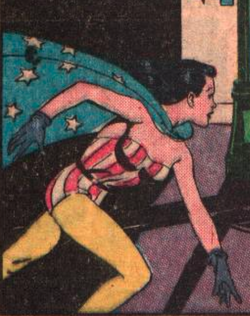
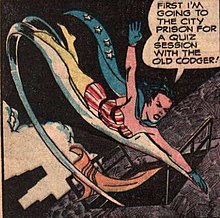
Yankee girl kkYankee Girl Chesler 002

The Public Domain Superhero Wikipedia lists them as Yankee Girl #1 and #2 (left to right respectfully). Confused yet? Don't worry, sit back, put on a podcast, or Yankee Doodle Dandy if you want to make me laugh (if you take a video of you playing Yankee Doodle Dandy and show this blog post I will give you a shout out on Twitter).

Now to keep this chronological, I'll start with Yankee Girl #1, who came first.

Yankee Girl #1 (Kitty Kelly)

Yankee Girl #1, or Kitty Kelly, first appeared in Punch Comics #1, published in December 1941. Unfortunately, Yankee Girl's creator is unknown. The creator, according to comicbookplus.com, might possibly be Ann Brewster, but this' unconfirmed. Kitty Kelly/Yankee Girl doesn't first in the magazine-like comic. Her story can be found on Page 28. You can read the entire comic on comicbookplus.com, which  I will link here to Kitty's first story. https://comicbookplus.com/?dlid=69658 

Kitty Kelly's main job is an air hostess, who sometimes work on trips for the US Army during WWII. Her story in Punch Comics #1 is not clear. In her first story, Kitty deals with Japanese saboteurs, and as you can see on page 29 (or 31 for you at home reading on comicbookplus.com) Kitty does not fall into the stereotype of the damsel in the distress. Though she does call for Ned's help on Page 28. And he wants her to wear and apron and be his wife. So there is that.
Comic Book Cover For Punch Comics #1
The artwork of Punch Comics #1 isn't exactly ground breaking, and some elements, mostly the portrayal of the Japanese, is very stereotypical. One thing that is worth praise in this story is that Kitty is very active in the story.

Comic Book Cover For Punch Comics #1
Kitty Kelly doesn't seem like a superhero in this first issue, she's more of a secret agent or traditional hero. One thing's for sure, as you can see in panel 4 on the above page, if she wanted to do the can can, well oh boy she can! 😎

All right, I promise that's the last pun I'll make.

Kitty Kelly doesn't appear to have been as popular as Punch Comics' publishers, Chesler Feature Syndicate (according to Punch Comics #2 Page 42), were hoping for. Kitty Kelly's story is pushed farther back in the book in Punch Comics #2 to page 42. Once again Kitty Kelly shows herself to be a badass.

Comic Book Cover For Punch Comics #2
Kitty Kelly did not come to play.

Kitty Kelly is somewhat inspirational. She gives the young Lieutenant the courage to step up to their enemies (unfortunately here portrayed as a Muslim stereotype). The story has definitely not aged well. While I have no idea what the numbers were for Punch Comics' sales, I do know that Kitty Kelly was removed from the comic after #2.

Kitty Kelly was relocated to Captain Flight Comics, and where she first appeared in Issue #6. However, if you're looking for a new story, then you're going to be disappointed. The story is a reprint from Punch Comics #2, but has a different cover.

Comic Book Cover For Punch Comics #2Comic Book Cover For Captain Flight Comics #6
Punch Comics #2 (on the left) and Captain Flight Comics #6. See the resemblance?

Kitty Kelly didn't appear in Captain Flight Comics #7. Why? I'm not entirely sure. I do have a suspicion that the writers decided to give Kitty a "reboot" if you will, but needed time to recreate the character. As you can see on the image of Captain Flight Comics #8, we now see how Kitty became called Yankee Girl.

Comic Book Cover For Captain Flight Comics #8Captain Flight Comics #8 Page 29

Comic Book Cover For Captain Flight Comics #8

Here Kitty, finally Yankee Girl, gets a costume, which is pretty uninspired. A few things I've noticed right off the bat:

1) Kitty's work is now a receptionist. Why the change? No idea. Maybe she was tired of getting shot down.

2) Kitty inexplicably has powers, such as hypnotism, and I assume strength, since the chair didn't seem to harm her.

I guess that Captain Flight Comics attempted to erase Kitty's first two stories, but kept the name to keep her original readers reading her story. So, how does this story perform versus the first 2?

Comic Book Cover For Captain Flight Comics #8

Well, as you can see, it's not a whole lot better. Instead of fighting stereotypes of Japanese or North Africans, now she fighting stereotypes of the mentally ill! Oh the 1940's were a... special time for comics weren't they?

Also, some idiot forgot to color in Yankee Girl's bottom part of her costume, which is kind of hilarious. These comics weren't exactly being made for the art, as you can see here. As the story progresses, Yankee Girl appears to possess the power of flight and invulnerability to bullets.

Moving on, in Captain Flight Comics #9, Kitty is pushed to the back of the book, and now the title is "Kitty Kelly: Yankee Girl." And she's back to being an air hostess.

Kitty was once again bumped to another book, and appeared in one issue of Red Seal Comics, #17. In this issue Kitty gains a different superhero costume, which was seen above. Which includes children dying...😐😐 YAY.

This issue also finally explains how Kitty Kelly's powers work, allowing her to become Yankee Girl. When she's under distress, Kitty's powers kick in.

Comic Book Cover For Red Seal Comics #17

We also finally get some proper superhero action from Kitty, and some changing fan service. I'm starting to notice a trend in these 1940's comics, which definitely hasn't stopped entirely.

Despite her versatility and ability to jump around to different books, Kitty's luck came to an end. Kitty's last original appearance was in Wonder Boy Comics #18, published in July 1955.

So how does Kitty's last story go.

Comic Book Cover For Wonder Boy #18 😳

WAIT A MINUTE!!!! 

That's right folks, they reprinted Punch Comics #2's story for a SECOND time. This' a really sad ending for Kitty's career.

And that is the sad ending of Kitty Kelly/Yankee Girl. The real question is, does she count as a Public Domain superhero? Technically.... yes, however she only appears as a superhero in a few stories, and even then the continuity of those stories is very confusing.

When I began researching this blog post I didn't expect a lot from Kitty Kelly, my main interest is in our next subject. However, I was pleasantly surprised with an interesting change of costumes and that hilarious reprint.

All right, now onto the main reason why I decided to write this blog post.

Yankee Girl (Lauren Mason)
Image result for yankee girl superhero

Yankee Girl, alias Lauren Mason was created by Ralph Mayo and published by Harry A Chesler.... wait a minute. Chesler, as in Chesler Feature Syndicates. Huh. I guess the Yankee Girls are more connected than I once thought.

Anyways, Yankee Girl (#2) first appeared in Dynamic Comics #23 in November 1947. Lauren's powers, unlike Kitty's, are much more clearly defined. In Dynamic Comics #23, Lauren gains her powers by saying the phrase "Yankee Doodle Dandy." Yankee Girl's powers seem to include flight and strength, but she can still be easily knocked out by a common thug.

Yankee Girl's next (and last) Public Domain appearance was in Danger #16. And for the first time, Yankee Girl is on the front cover!

Comic Book Cover For Danger #16

Yankee Girl's costume changes yet again, she looses the yellow leggings, replacing them for red boots, and her cape has less stars on it. The stripes on her costume have also decreased. This would be the last story where Yankee Girl would appear under the legacy of Harry A Chesler.

HOWEVER, this was not the end of the character's career!

AC Comics 

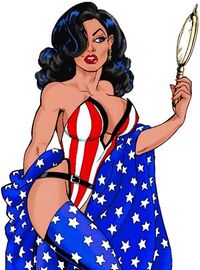
Yankee Girl Image (C) AC Comics. Used under fair use.  https://accomics.fandom.com/wiki/Yankee_Girl
AC Comics, a lesser known comic book company, decided to bring back Yankee Girl. Because the company which published Yankee Girl went out of business, Yankee Girl fell into the Public Domain. Which means that anyone, including AC Comics, were able to use her.

Yankee Girl had a solo run under AC Comics, and was also apart of AC Comics' team FemForce, created in 1985. According to AC Comics' website, Yankee Girl still has new stories as of 2012 with the publication of Yankee Girl: Stars & Stripes Forever #1.

AC Comics also gave Yankee Girl's costume a redesign, which you can see above. Personally, it's nice but very objectifying. It's not the most objective costume mind you, but doesn't sit with me that well in all honesty.

Yankee Girl has also appeared in a short animated film by Nightveil Media, who have some connections with AC Comics. Which states that it's not for kids... and has her fighting a mostly naked Communist looking woman.... 😕

The animation doesn't appear to be of a big budget, and in all honestly... doesn't look good. I can't pass judgement, since I haven't seen it, and have left a link if you're curious and want to buy it, but don't personally recommend it. And now for some Fun Facts!!

Fun Fact:

Despite being called Yankee Girl by the Public Domain Superhero Wikipedia, Kitty Kelly's first title card doesn't read Yankee Girl! On Page 28 it actually reads Kitty Kelly.

Kitty Kelly doesn't appear in a true superhero costume until her 6th appearance in comics.

Kitty Kelly/Yankee Girl's last appearance also has Phantom Lady, a character most people may recognize from DC, where she has new comics made.

Within Danger #16 Yankee Girl's boots change from red on the cover to blue in the book. (I know that's not so great, bare with me, I'm struggling to find Fun Facts)

AC Comics publish a series with Golden Age, Public Domain superheroes like Yankee Girl, called Golden Age Greats. If you're curious and want to buy the series, you can check my sources below.

Conclusion

Yankee Girl is probably the best example of how a public domain character can be given a second lease on life thanks to the public domain. From her humble origins as a Air Hostess, to a Superhero in an all female team, Yankee Girl's history is very ranged. Not all of her stories (past or present) are good, but there is a certain charm to this character.

If you asked me which version I prefer, I would say Lauren Mason. She has a much more interesting costume, and does a lot more superhero-ing.

And now for a new section I like to call

How I'd Use the Character

Personally, I would try and use both Yankee Girls, and maybe have them have a friendly rivalry. I'd probably keep Lauren Mason as Yankee Girl, and change Kitty Kelly to something else. I likely wouldn't change the costumes a whole lot, but would make some changes to make them more unique. I'd keep Lauren's yellow leggings but make the boots a different character.

Will I ever use Yankee Girl? Whose to say. But I will say, Luck be a Lady...

And that is all I will say. Thank you for reading this very long blog post. I hope you enjoyed it. If you'd like to read more blog posts in the future, follow me here on on Twitter, @ConductorPat, where you can also interact with me. If you'd like to, let me know how YOU would use Yankee Girl. And which version do you prefer?

Thanks for reading everyone. Remember to keep writing, and I'll see you on the Tramway!

Sources:

Captain Flight Comics #6 https://comicbookplus.com/?dlid=23757

Captain Flight Comics #8 https://comicbookplus.com/?dlid=40267

Captain Flight Comics #9 https://comicbookplus.com/?dlid=28443

Chesler/Dynamic Comics. https://comicbookplus.com/?cid=823

Danger #16 https://comicbookplus.com/?dlid=15231

Dynamic Comics #23 https://digitalcomicmuseum.com/preview/index.php?did=12669

FemForce https://comicvine.gamespot.com/femforce/4060-27873/

Golden Age Greats. https://accomics.com/product-category/golden-age/gollden-age-greats-spotlight/

Punch Comics #1 https://comicbookplus.com/?dlid=69658 

Punch Comics #2 https://comicbookplus.com/?dlid=27297

Red Seal Comics #17 https://comicbookplus.com/?dlid=40862

Yankee Girl (Kitty Kelly) https://pdsh.fandom.com/wiki/Yankee_Girl_(1)

Yankee Girl (Lauren Mason) https://pdsh.fandom.com/wiki/Yankee_Girl_(2)

Yankee Girl: Stars & Stripes #1 https://accomics.com/product/yankee-girl-stars-and-stripes-forever-1/

Yankee Girl Vs. The Colossal Crossack

www.nightveilmedia.com/downloads/yankee-girl-vs-the-colossal-cossack-download


Thursday, July 25, 2019

Tugs: The History & Legacy

"The Tugboat, for it's size, is the most powerful craft afloat. And the Star Tugs, are the power behinds the docks and waterways that make up the Bigg City Port. This, is Tugs." 

Welcome back Star Tugs, (and hello to first time visitors), to Tug & Tram Blogging.

The above quote is from the intro of one of my favorite children's shows, which I learned about in my teen years. Today we will dig into Tugs: the history of the show, and it's legacy. Well, let's get into it. 
(Please note a lot of my info will come from the Tugs Wiki, and I will try hard to not just rehash what they have. Sources below). 

Background Info

Before going into the show, let's discuss some of the creative people behind the show.

David Mitton, according to TugsWiki, was born in Edinburgh in 1938, and in 1965 began work on children's shows. He began under Gerry Anderson, the creator behind many famous Supermarionation (I.E. puppetering shows) such as the original Thunderbirds.

At some point, David Mitton met Robert D. Cardona. Robert D. Cardona is an American show producer born in 1930, who worked on British shows such as The Flaxton Boys, The Four Feathers, Fraud Squad, Crimes of Passion and Emmerdale.

Robert. D. Cardona and David Mitton hit it off, and became friends. Together they would form Clearwater Features, and would help shape an important part of many people's childhood.

Production

Clearwater Features was based out of Shepperton Studios in England. It was here at Shepperton Studios that Clearwater Features would work on their most famous production. Not, it's not Tugs, we need to discuss a different show first, one which you're most likely more familiar with.

Clearwater Features produced the first two seasons of what would become Tugs' sister show, Thomas the Tank Engine & Friends. Working alongside Britt Allcroft, the main creator behind Thomas' tv show, Mitton and Cardona directed episodes of Thomas and Friends for the first two seasons, working on Thomas from 1984 to 1986.

After Season 2 of Thomas & Friends, Mitton and Cardona decided they wanted to create a new show. Their discussions and planning would lead to Tugs. The main inspirations for Tugs were the Disney short Little Toot and the tugboat fleets of San Fransico and New York, which we will get into later when we discuss the characters. Clearwater Features began making the show in the late 1980's, using large scale models, like Thomas the Tank Engine. In fact, Clearwater Features would use many of the same production techniques for Thomas on Tugs.

For example, the remotes used to move the eyes of the characters were the same used to make Thomas and his friends move on set.

The Tugs models, ironically, did not actually float. They were moved around on wheels, and the tugs were weighed down to appear to be floating. Motors were too heavy, so the Tugs were pulled through the water with string.

The set of Tugs was built around a giant water tank, 45 by 25 feet, the water was 14 inches deep. The crew had to wear galoshes to change the character's faces, and bend down, which according to the Tugs Wiki left them with cramps after the show finished production.

So here's an early fun fact for you, Tugs, unlike Thomas originally, had a voice cast for the characters, with Captain Star acting as narrator, reflecting back on the events of the show.

The music of the show was composed by Mike O'Donnell and Junior Campbell, who also worked on Thomas.

All right, let's get more into Tugs' Story.

Story

Tugs takes place in the 1920's, with two fleets of tugboat companies, the Star Fleet (also called the Star Tugs) and Zed Stacks, competing for work in the fictional town of Bigg City Port. During the series the tugs would go to other locations for work. For example, in some episodes the tugs would travel up River for work. The Tugs never left the local region of Bigg City Port, except for one of the Star Fleet, Hercules, which we never saw in the show.

Tugs had several locations in Bigg City Port which we saw. The Star Dock is the home of the Star Fleet, and their counterparts' dock is the Zero Dock. The Star Tugs report to Captain Star, who we never actually see in person. Instead, Captain Star gives his orders via a megaphone. The same came be said for Captain Zero, owner and manager of the Zed Stacks.

Lucky's Yard is the equivalent of Thomas and Friends' Steamworks, where characters are repaired, and Sally the Seaplane lives.

Dem Der Rocks is a dangerous location for ships, which has claimed many ships in accidents. To protect the Tugs and visiting ships, Lillie Lightship (who is not owned by Captain Star or Captain Zero) protects ships by sitting in place and flashing her light to warn away ships. Speaking of Lillie, let's dig into the characters.

Star Tugs

There are 8 members of the Star Fleet/Tugs.

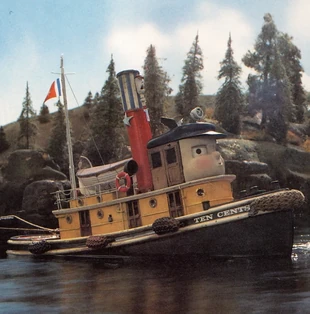
No. 1 Ten Cents

Image taken from the Tugs Wiki. Used under Fair Use.

Tugs is described by the Tugs Wiki as the main protagonist of the show. Ten Cents is a switcher, which means he is built for working in ports and not go onto the ocean. Tugs, like the other Star Tugs, is based on tugs that worked in San Francisco, which is why he's name Ten Cents. Despite having an American basis, he is a British tug.

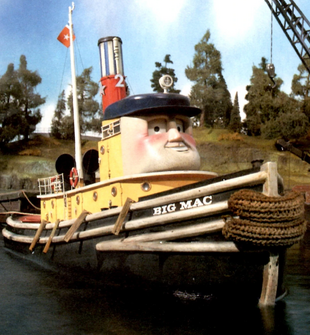
No. 2 Big Mac

Image taken from the Tugs Wiki. Used under Fair Use.

Big Mac is one of the heavier haulers of the Star Tugs, and is often one of the more level headed members of the fleet. He does have a temper, and can be easily distracted when someone insults his friends. He can often be gruff and be easily annoyed by other members of the fleet, such as No. 5.

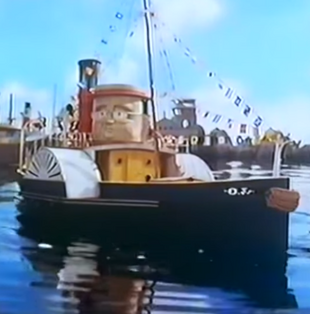
No. 3 O. J.

Image from the Tugs Wiki. Used under Fair Use. 

O. J. is the oldest member of the Star Tugs, and the last paddle tug used in Bigg City Port. O. J. is the wisest member of the Star Tugs and when he can't always help with his strength, he can provide his wisdom. O. J. stands for Old Jones, according to the Tugs Wiki. O. J. is often trusted by Captain Star to oversee tasks.

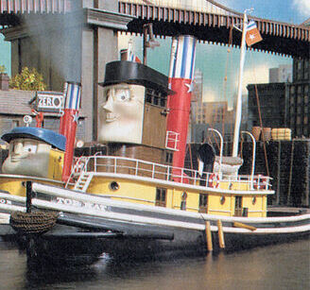
No. 4 Top Hat

Image from the Tugs Wiki. Used under Fair Use. 

Top Hat is the smug member of the Star Tugs, and normally complains about some of his jobs, in particular garbage runs. He is a hard worker, but does come off as a Posh snob, and even the Star Tugs will get annoyed with him.

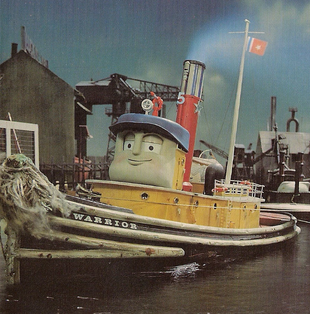
No. 5 Warrior

Image from the Tugs Wiki. Used under Fair Use. 

Warrior could be described as the dumbest member of the Star Tugs. I like to see him more as a special needs representation. Warrior is stronger than he is smart, but he does prove himself to be smarter than other tugs give him credit. This' shown in particular in the last episode of the show, Big Freeze, when he sets Garbage on fire to give an important ship, the Vienna, a light to come in safely. 

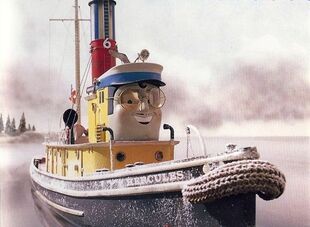
No. 6 Hercules
Image from the Tugs Wiki. Used under Fair Use. 

Hercules is the largest and strongest member of the Star Tugs. He isn't seen in the show a lot, and only appears for small appearances towards the beginning or ends of episodes. Hercules is an ocean going tug, and his main work includes answering rescue calls and bringing in ships to port. Hercules often helps lead the tugs in operations in and out of the port. 

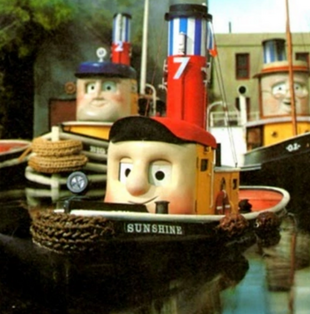
No. 7 Sunshine
Star Fleet
Image from the Tugs Wiki. Used under Fair Use. 

Sunshine is the newest tug member of the Star Fleet. He is also the smallest and most inexperienced. Sunshine appears in the first episode of Tugs (spoilers for Tugs Episode 1: Sunshine)

In his first appearance Sunshine is a new tug who is being put on trial to help out the Star Fleet. He used to work up River, and knows a lot about the operations up river, which comes in handy in Episode 13 Big Freeze. 

Sunshine often works with Ten Cents, and the two appear to be best friends. Together the small switchers can complete a lot of jobs.

There is another member, but again, Spoilers for Tugs

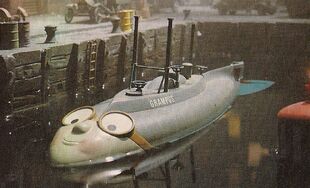
Grampus
Image from the Tugs Wiki. Used under Fair Use. 

Grampus is a Navy Submarine who is based in Bigg City Port. He is friends with the Star Tugs and helps out anyone in need, which we see in the episodes Pirate and Regatta. Grampus is saved by the Star Tugs when he is withdrawn from the Navy in Regatta. Grampus is known for accidentally spitting water into other Tug's faces when he resurfaces. 

Zed Stacks 

The Zed Stacks consist of 5 tugs, making them smaller than the Star Tugs.

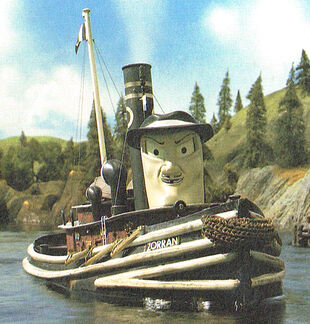
No. 1 Zorran

Image from the Tugs Wiki. Used under Fair Use. 

Zorran is the main antagonist of Tugs, and is the de facto leader of the Zed Stacks. Zorran often attempts to plan up schemes to help the Zed Stacks get ahead of their competition, but this usually backfires on him.

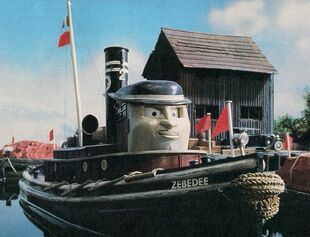
No. 2 Zebedee

Image from the Tugs Wiki. Used under Fair Use. 

Zebedee is arguably the most "good" of the Zed Stacks. At the least he's as the Tugs Wiki describes him, a "conflicted" character. Zebedee is much less antagonist than the other Zed Stacks, but always sides with his fleet, and is described as Zorran's right hand tug. Zebedee often works with Zak, and the two could be described as best friends.

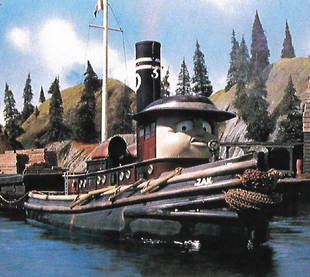
No. 3 Zak

Image from the Tugs Wiki. Used under Fair Use. 

Are you starting to notice a trend with the names of the Zed Stacks? That's right, they all start with Z.

Let's get back to Zak. Zak, unlike his friend Zebedee, is a callous thug, who is willing to go along with Zorran's schemes.

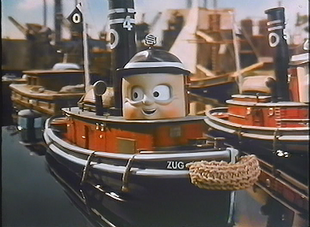
No. 4 Zug

Image from the Tugs Wiki. Used under Fair Use. 

Zug attempts to create schemes like Zorran, but his usually fail more quickly than Zorran's. He's not as confident as Zorran or the other Zed Stacks. Zug can easily be panicked when pushed too hard, in particular by Zorran. 

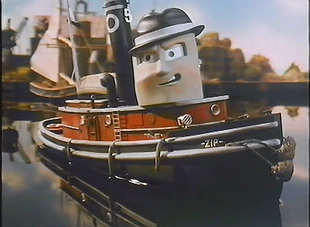
No. 5 Zip
Image from the Tugs Wiki. Used under Fair Use. 

Zip is arguably the dumbest of the Zed Stacks, and works with Zug most of the time, in competition with Ten Cents and Sunshine. According to the Tugs Wiki, "Zip is often described as Zug, but worse." Zip is a corwardly tug who backs down easily when confronted. A gag is that he doesn't know what some words, such as Devious, mean.

Non-Tug Fleet Characters

All right, to keep this from being too long of a blog post, I will just name a few non tug characters, and leave out their pictures (if you are curious, I will leave a link to the Tugs Wiki).

Other recurring characters are Billy Shoepack, the alligator tug (who moves close to the water) who is a demolition "expert" if you can call him that. He does attempt to help, using explosives, which often leads to shenanigans.

Another character is Puffa, a steam locomotive who is friends with the Star Tugs. Puffa, unlike characters in Thomas & Friends, does not have a face. Like Captain Star, Puffa speaks using a megaphone.

Show Run

Clearwater Features took a year to make the first season of Tugs, which consisted of 13 episodes, from 1987 to 1988. The show began running on Children's ITV in the UK, Australia, Finland, Singapore, Brunei, France, France and Japan. For some reason the show, unlike Thomas, was not sent overseas to North America.

A second season was planned for Tugs, but unfortunately this never happened. Clearwater Features closed on New Year's Eve, 1990. Television South, which owned the rights to Tugs, would also go bankrupt, according to the Star Tugs Trust website.

Now, the rights to who owns Tugs today is super complicated. After TVS closed, Robert Cardona retained 50% of the rights, the the other 50% belonged to Castle Communications, who distributed VHS tapes of Tugs. Britt Allcroft almost saved the show, but this sadly did not happen. Which is truly sad when you learn what the Tugs were used for next. First, let's discuss the use of the models.

Later use of the Models

After Tugs shut down, David Mitton would return to Thomas and Friends, and Britt Alcroft would purchase the Tugs models, using them from 2001 to 2008, when the show would switch to CGI. The models were heavily modified for their appearances in Thomas and Friends. O. J., for example had his face removed and was renamed "Lakesider III," and appears in the Thomas episode "Peter Sam & the Refreshment Lady." O. J. wears this guise to this day.

In 1995, Cardona (who was now working in Canada) and Castle Communications sold the 50% stake of the rights to Tugs to Sunbow Productions. They would use the Tugs footage to create....

Salty's Lighthouse (Or, the WORST thing to happen to Tugs) 

Sunbow Productions created the educational show called Sunbow Productions, which ran from 1997 to 1998. The main character of the show, a young boy named Salty (not the same character from Thomas) who lives with his friends in his lighthouse. Salty's Lighthouse is universally hated by Tugs fans (such as myself). The original voice actors were dubbed over, Salty's Lighthouse renamed Big Mac Big stack, OJ became Otis (probably due to O. J. Simpson), Zebedee was called Zeebee, Sunshine was voiced over and turned into a girl, who is Ten Cents' sister....what? The show was "babied" and dumbed down. Bigg City Port was also renamed to "Snuggleboat Harbour." Ugh.

Down the Rights Rabbit Hole

Apparently Cardona regretted selling the rights, and tried to get Castle Communications to buy the rights back to get Tugs VHS tapes recirculating. Unfortunately Castle Communications decided to focus more on music. Eventually Castle Communications would become the Sanctuary Group, and signed Indie band Keane, and were later bought out by Universal.

As for Sunbow Productions, they were bought by Sony Wonder, a division of Sony Music in 1998, and the TV Productions were sold to German company TV Toonland in 2000 for $20 million (US). They certainly didn't buy Sunbow Productions for Tugs. According to the Transformers Wiki, Sunbow Productions had the rights to several Hasbro cartoons, including Transformers (G1) and G. I. Joe.

In 2008, TV Toonland began to go under, so they sold the rights to the Hasbro series back to Hasbro for $7 million, and in 2009 they went bankrupt. The non-Hasbro rights were sold to m4e in 2011.

Here's the crazy thing though....I recently checked m4e's website, in particular their library of IP's. While Salty's Lighthouse is included, Tugs is nowhere to be seen. I tried searching Tugs on their website as well, with no results So who owns it? I would assume m4e, but they may not know it? Which might mean, pulling on my Public Domain Cap, that it would possibly make Tugs an "Orphan Work," where the owner does not know they own it. (Sh.... don't tell m4e).

Online Fandom & Legacy

Tugs would have been a forgotten series, if not for the internet. Thanks to YouTube, all of the 13 episodes of Tugs have been uploaded by fans from VHS tapes, and the fandom began to grow. In a way the Tugs Fandom, like the show, is a sister Fandom to Thomas and Friends. The fandom started in 2002, and was boosted by the Thomas Fandom.

There has also been fan projects of Tugs. The biggest was TUGS Audio Productios, which gained praise from composer Mike O'Donnell.

There were plans for a CGI fan made series, but this has not progressed.

One of the newest Tugs projects is the Stories of Sodor (which includes Ten Cents). Victor Tanzig, the creator of the show, took the show's premise and changed it to include characters from Thomas and Friends. Currently Mr. Tanzig is on hiatus while he works on his real life job and takes care of his mental health. If you are interested in seeing his first 3 seasons, you can check out his YouTube channel here: www.youtube.com/user/Ectcanaseremptus 

The Star Tugs Trust

The fate for the models of the Tugs is a happy one. After model production of Thomas & Friends ended, the models went to the company with the largest stake in them (m4e I believe?) The Chairman of the Company didn't want to see the models thrown away, and asked the board to store them. They weren't interested in this, so the Chairman took the models home with him, and kept them until 2010.

The Chairman got in contact with with a man named Richard who could restore the Tugs models, and he began the work until 2012. The models, still in the UK, were taken to Norwich for restoration by Richard, a boat enthusiast, who saw it as a retirement project. Circumstances would change. At some point, the Chairman sold the models to Richard. In November 2012, Richard approached a group of fans to help him send the Tugs to good homes, such as people behind the show.

However, there was the risk the collection being dispersed and models lost to the public. So the Star Tugs Trust was founded. On January 26, 2013, the Star Tugs Trust met at the Brook Hotel in Norwich to take over ownership of the models.

The Star Tugs Trust owns a coach and displays the models at the Midland Railway in Butterfly, Derbyshire. The Tugs have been displayed at other locations as well. At the date of writing, the Star Tugs Trust has displayed the Tugs models in 10 different locations, and the list shall keep growing.

Many of the cast members, David Mitton, Robert D. Cardona have passed. Mike O'Donnell and Junior Campbell are still alive. I am not sure how active they are in interacting with fans, and do not believe they interact with either the Thomas or Tugs Fandom.

All right, that's all the information I have on Tugs, before you go, here's some fun facts!!

Fun Facts:

Shepperton Studios is still used today, according to the Pinewood Group. According to Film London.org, Harry Potter was filmed here.

Tugs fans thought that Dem Der Rocks was Dender Rocks, until corrected in an interview with a staff member with The Star Tugs Company.

The Tugs' whistles have mouths, for some reason. It took me a very long time to notice this, and I didn't realize it until it was pointed out in a video.

Despite what you might think, Big Mac was not named after the Big Mac sandwich of McDonald's. According to Big Mac's bio on Tugs Wiki, his name refers to his Scottish heritage. Big Mac was renamed Big Stac for the American show Salty's Lighthouse to avoid a lawsuit with McDonald's. And looking back...I don't blame them.

Big Mac's smiling face was separated from his model and was not reunited with the model until 2014.

Grampus was based on the Plunger class of Submarine, named after USS Grampus (USS-4). The USS Grampus was sunk as a target in 1922, which was the basis for the episode Regatta.

A Grampus is a type of Dolphin, known as a Risso's Dolphin or Blunt Nose Dolphin.

Grampus rode on the same trolley as the tugs, but unlike them because of his size he could move up and down.

While the Star Tugs Company owns Grampus' face models, the location of his model, along with Top Hat's, is unknown.

The basis for the Zed Stacks was the Moran Tug Fleet of the 1920's.

In the episode Regatta, Big Mac pulls a barge with the Clearwater Features logo on it, which you can see below.
Regatta237
Image from the Tugs Wiki. Used under Fair Use. 

BONUS FUN FACT!! Sorry I forgot to include this the first time. According to the Tugs Wiki, Robert Cardona would move to Canada and work on a similar show, Theodore the Tugboat, which was very similar to Tugs, but for a younger audience. I was introduced to Theodore first, and have fond memories of Theodore from my childhood. Maybe I'll do a similar post for Theodore in the future.

If you'd like to see a video of Tugs under production, check out this short video on YouTube. www.youtube.com/watch?v=kw7S3dpH68E

If you would like to watch the show, but don't know which episode to start with, please refer to this list on the Tugs Fandom Wiki. https://tugs.fandom.com/wiki/Episode_List


Thank you all for reading this blog post, and I hope you enjoyed it. I'm a big Tugs Fan myself, and I accidentally stumbled across it via YouTube, and I'm glad I did.

Personally, I'd love to do a reboot of Tugs, but not go the route David Mitton wanted to go, which was to move the series up river (because it was easier to film there than Bigg City Port). I would go with the idea of introducing new tugs, perhaps some female tugs, and keep the series focused in Bigg City Port, perhaps move the story from the 1920's into the 1930's and deal with the Great Depression.

All right, that's all for me in this post. It's been a long time coming (I had this planned back when I started the blog) and I'm glad to have it finished. Thanks for reading. Remember to keep writing and I'll see you on the Tramway!

Sources

"David Mitton." Tugs Wiki. https://tugs.fandom.com/wiki/David_Mitton

"Dem Der Rocks." Tugs Wiki. https://tugs.fandom.com/wiki/Dem_Der_Rocks

"Program Library." m4e. www.m4e.de/en/program-library

"Robert D. Cardona." Tugs Wiki. https://tugs.fandom.com/wiki/Robert_D._Cardona 

"Salty's Lighthouse." Tugs Wiki. https://tugs.fandom.com/wiki/Salty%27s_Lighthouse

"Shepperton Studios." FilmLondon.org http://filmlondon.org.uk/shepperton-studios

"Shepperton Studios: Stages & Facilities" Pinewood Group.     
www.pinewoodgroup.com/studios/shepperton-studios/stages-facilities 

"TV Toonland." Transformers Wiki. https://tfwiki.net/wiki/TV-Loonland


Sunday, March 17, 2019

Luck is a Lady: The History of Lady Luck, the Forgotten Golden Age Superhero

12/28/2020 Update: Some of the facts on this blog post, through new research, have come to
light as incorrect. Lady Luck is ⓒ by the Eisner Estate. This blog post also does not reflect my
current writing abilities. For the sake of transparency, I will leave the rest of this blog post unedited.

Hello my Star Tugs, I hope you’re all doing well. (And if that reference confuses you, 
don’t worry, I’ll explain it in a future blog). I apologize for the lack of blog posts, I’ve been 
super busy as of late. And facing computer problems.

Unfortunately my laptop battery is dying, so I might be using it even less in the future. 

I’m not sure if I’m taking a risk using it now, it IS plugged in, but the battery refuses to charge. 
It’s at 6% and keeps jumping up and down from 9%.

No matter, I’ll survive until I buy a new battery.

Well, with that out of the way, let’s get onto the history of Lady Luck, and why I’m writing about her.
Bare in mind this might be similar to a Mr. Rogues video, so Mr. Rogues, if you see this (hello!) and 
sorry if I seem to be ripping you off, that’s not my intention. I’ll leave a link below if you want 
to check out his channel here.
Origin
Origin
Lady Luck was created by Will Eisner with art done by Chuck Mazoujian, according to  
FuryComics.com. She first appeared in 1940, according to Comic Vine, in The Spirit #1, published by 
Quality Comics, a now defunct company. I’m currently reading The Spirit #1 on ComicBookPlus.com,
and if you’re curious I’ll link the story here.

Here’s Lady Luck’s personal run, which I’ll discuss in a moment. 

Regarding her origin story, it’s bog standard for the era, except she’s a woman. Brenda Banks, aka 
Lady Luck, is tired of being wooed by men after her money, so dresses up as a superhero to fight crime.
Lady Luck would be published in a newspaper strip until 1946, during which she went through several 
different artists and writers. Dick French and Charles Mazoujian were early writers, and Nick Cardy and
Klaus Nordling would also later draw Lady Luck.

Lady Luck was dropped from the newspapers in 1946, and Quality Comics published her stories in the 
title Smash Comics, according to Comic Vine. Lady Luck would eventually have the book named after 
her, until 1950 when the title was cancelled, having five issues named after her, from Lady Luck #86 
to #90.

Nicholas Viscardi, as Nick Cardy was also known, added Peecolo, Lady Luck’s Italian Chauffeur and
sidekick. Peecolo was written with a clichė Italian accent, which can be seen in...well, any of the 
comics he appears in.

I personally have only read the comics on FuryComics.com, Lady Luck #86 to #90. However, I 
have done a little bit of research. Here’s some fun facts:
  • Lady Luck was one of the earliest female superheroes, coming out in the same era as  
    Wonder Woman.
  • Lady Luck appeared in 125 issues.
  • Lady Luck’s gloves in some variants have 4-leaf clovers on them.
Also, Lady Luck’s creators impressively didn’t show off her body. I mean, given it was the 1940’s 
this was pretty...
Oh good lord.
I mean, admittedly, this didn’t, as far I can tell this didn’t happen a lot, but… ugh. This’ one thing 
I hope doesn’t continue.
So since I haven’t read a lot of Lady Luck stories (I don’t even know what issue the panel above 
comes from, which shows my ignorance) I might have to update this. I can say that I think there’s 
few recurring characters, I know there’s her father Mr. Banks, Peecolo, Hardy Moore, 
a Police Chief/love interest, though he didn’t appear in her last issues, and… The Count. 

I hate The Count. He’s an annoying comedic relief character who also got a spinoff title in 
Lady Luck’s later book. Why? I don’t know. I guess even in the 1940’s/50’s writers made 
the mistake of taking a comedic character and trying to give them their own series. You can 
see this in Lady Luck #86, which admittedly while it is kind of funny, I was more interested in 
the action. So, after 1950, what happened to Lady Luck? You might ask. Well…

Free to Use by ANYONE
Because Quality Comics went under, the copyright on Lady Luck wasn’t renewed, so 
ANYONE can use her. That’s the really cool thing: unlike say Batman, Superman, or Captain America, 
she’s not stuck with a status quo of a company, she can be changed in any way.
(Update: She might technically be owned by DC).
You could set her in the Modern Day, in the future with Star Wars-esque weapons, or stick to the
time and make a gritty, noir story.

I discovered Lady Luck while scrolling through the Public Domain Superhero Wikipedia, and saw her 
as a recommended subject. I added her to my 60+ page document of characters to use (including their
photo and a few notes) then moved on. But Lady Luck stuck with me. I’m not what exactly it was, but I
fell in love with the character (not in the romantic way, you sickos, I mean I think she’s cool, 😜), and 
eventually found the comics.

Though the sad part is, because she’s Public Domain, Lady Luck and hundreds of other characters 
have been forgotten. And I hope, by writing about her, to give her some well needed spotlight. I 
encourage my fellow writers to consider looking at Lady Luck, as I did.
When I learned that Red Cents, a yearly published book on my campus, was calling for submissions, I 
submitted a short story I wrote of Lady Luck. I thought “This’ll be the first Lady Luck story published 
in 60+ years,” and began to imagine using that for a chapbook introduction, well….

DC Run
So it turns out in that DC, for their New 52 continuity, brought back the character, which legally they 
can do since she’s Public Domain. I believe it was announced in 2012, and she first appeared in 
The Phantom Stranger #6. (Update: As stated earlier, DC might technically own Lady Luck, her
ownership is unclear. 3/2/2020).
When I found this out I was initially scared and feared it would be similar to my idea. However, they 
seem to have pulled a bit from Fantomah, another early Golden Age superhero, by giving her the ability
to change her facial appearance…. and have a skull face (the skull face is from Fantomah btw).
Personally… this doesn’t sound like the Lady Luck I know and love. BUT, if it reminds more people 
that Lady Luck exists, then I’m all for it. Also, can’t judge what you haven’t read, right? I would like to
read The Phantom Stranger #6, unfortunately I’m a poor college student and can’t afford it. 
Maybe in the future.

Conclusion
Well, that’s about it for Lady Luck, and my time on my laptop for now. 
The battery’s dying and I think I better log off. Or I'll just ignore it because homework calls.
Thanks for reading, see you on the Tramway!


Sources:
"Lady Luck." Comic Vine. https://comicvine.gamespot.com/lady-luck/4005-35407/
"Lady Luck." Fury Comics. http://furycomics.com/viewer/4/Lady_Luck/